When manufacturers ask, “what is the lifespan of industrial laser cutting machines,” the honest answer is rarely a single number. A well-maintained fiber laser cutter may operate productively for 10 to 15 years. Its laser source can often reach 50,000 to 100,000 operating hours. Mechanical accuracy may decline sooner.
David Belforte, a respected industrial laser analyst and editor, has often emphasized the cost of downtime: “The most expensive laser is the one that is not running.” That idea matters on a busy factory floor. A dirty protective window, unstable cooling system, or worn linear guide can reduce cutting quality before the laser source fails. Small problems become expensive when ignored. Sometimes, the machine appears healthy.
In practice, service records reveal more than the purchase date. Operators should inspect beam quality, cutting speed, edge condition, chiller temperature, and positioning accuracy. Stainless steel parts with rough edges may signal focus problems, contamination, or mechanical wear. Preventive maintenance, clean optics, correct gas pressure, and trained operators can extend reliable production life.
Still, the estimate is imperfect. A machine cutting thin sheet eight hours daily faces different stress than one processing heavy plate around the clock. Software support may also end before the frame becomes unusable. Therefore, lifespan should include productivity, repair costs, safety performance, and available parts. A ten-year-old machine can outperform a neglected five-year-old model. The title promises a number. The factory needs a decision.
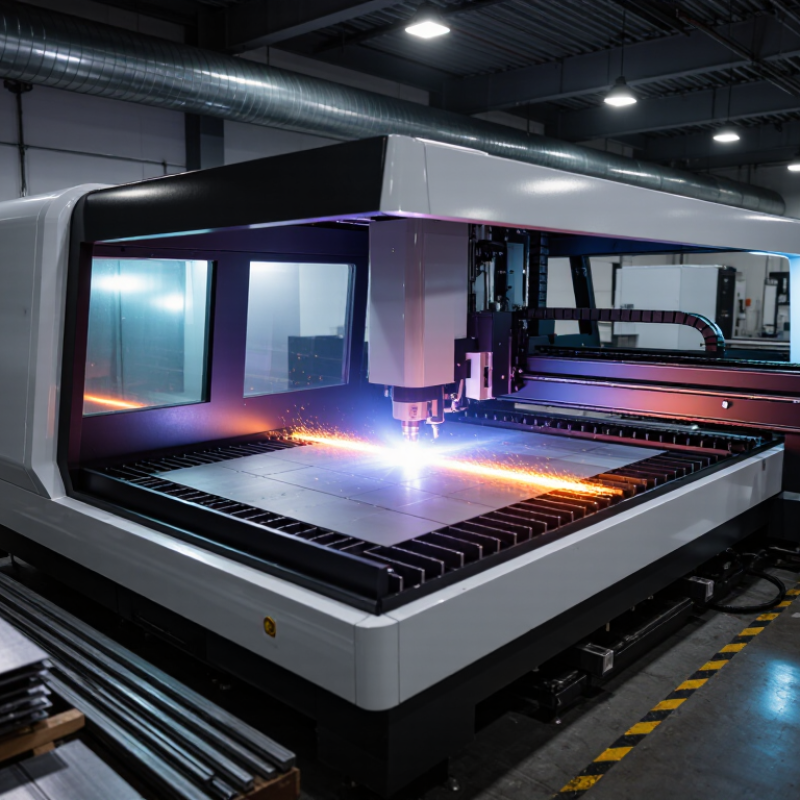
How Long Do Industrial Laser Cutting Machines Last?
What Determines the Service Life of an Industrial Laser Cutting Machine?
An industrial laser cutting machine commonly works for 8 to 15 years. Its actual service life depends on workload, maintenance, operating conditions, and component quality. A machine cutting thin sheet occasionally faces less stress than one processing thick steel for two shifts daily. Usage matters greatly.
Clean optics are essential. Dust on the protective window can absorb laser energy and create heat damage. Operators should inspect the window regularly and replace it when clouding, pitting, or discoloration appears. Cooling systems also require attention. Stable water temperature protects the laser source, while blocked filters can quietly reduce performance.
Alignment affects both accuracy and mechanical stress. Small errors may produce rough edges, forcing repeated cuts and increasing operating hours. Lubricated guide rails, correct gas pressure, and timely software checks also support steady production. Keep records.
In real workshops, neglected details often shorten machine life faster than heavy workloads. A poorly maintained machine may lose cutting quality within a few years. However, service estimates are never absolute. Power fluctuations, vibration, humidity, and operator habits can change the result. Even experienced teams sometimes overlook gradual wear in cables, bearings, or drive systems. Periodic inspections by qualified technicians help identify these problems before repairs become expensive.
Typical service life depends on operating hours, cutting load, environmental conditions, preventive maintenance, and the quality of replacement parts. The planning ranges below represent common industrial expectations rather than manufacturer guarantees.
How Long Do Industrial Laser Cutting Machines Last?
Typical Lifespan of Major Laser Cutting Components
An industrial laser cutting machine often lasts 10 to 15 years with disciplined maintenance. Its major components age at different speeds. A fiber laser source commonly operates for 50,000 to 100,000 hours. Actual life depends on power levels, operating temperature, and service quality. A CO2 source may require replacement sooner, often after 20,000 to 40,000 hours. These figures are useful, but they are not promises.
The cutting head usually remains reliable for three to seven years. Frequent collisions, dust, and poor nozzle alignment can shorten that period. Protective windows and focusing lenses need regular inspection. Consumables fail sooner. Nozzles may last days or weeks under demanding production conditions. The motion system, including rails, drives, and motors, often serves for five to ten years. Clean rails and correct lubrication make a visible difference.
Chillers typically last five to eight years, while extraction equipment may need major repairs earlier. In busy workshops, technicians often find that neglected cooling causes expensive secondary damage. I have seen machines with excellent sources but worn guides and unstable positioning. That is an important weakness in simple lifespan estimates. Performance may decline before complete failure appears. Operators should record cut quality, energy use, vibration, and alarm frequency. A machine can still run, yet produce rough edges and inconsistent dimensions. Regular calibration remains practical, not optional.
There is no fixed number. A well-maintained industrial laser cutting machine may operate for a decade or longer. However, operating conditions decide whether that estimate feels realistic. Heat, dust, vibration, humidity, and unstable power accelerate wear in optics, motion rails, cooling units, and electrical cabinets. The 2023 U.S. Department of Energy Operations & Maintenance Best Practices Guide reports that predictive maintenance can reduce costs by 8–12% compared with preventive maintenance. It can also reduce costs by 30–40% compared with reactive maintenance.
The estimate is useful, but imperfect.
In busy shops, a cutting head faces rapid starts, metal smoke, and abrasive dust each week. A chiller running near its limit can quietly shorten component life. Poor extraction leaves a gray film on protective windows. That small detail becomes expensive. ISO 55000 lifecycle guidance supports recording temperature, vibration, alarms, and repair history, rather than judging age alone. Technicians often find that two machines with similar hours age very differently. Production intensity matters. So does cleaning discipline.
Tips: Keep enclosure temperature stable and log it daily. Replace filters before airflow drops. Inspect protective windows under consistent light. Check coolant quality and leaks weekly. Track vibration, power alarms, and cutting quality. Review the records monthly with maintenance staff. Do not extend service intervals blindly; production pressure can hide early damage.
How Long Do Industrial Laser Cutting Machines Last?
Maintenance Practices That Extend Equipment Life
An industrial laser cutting machine can often serve for 10 to 15 years with disciplined maintenance. Its actual life depends on workload, material, operating environment, and repair quality. Daily checks should include the nozzle, protective window, lens area, and cutting bed. Remove metal dust before it reaches moving assemblies. A clean optical path supports stable power and sharper edges.
Keep cooling systems within the specified temperature range. Inspect filters, hoses, pumps, and coolant levels on a fixed schedule. Small leaks can become expensive failures. Lubricate guide rails and ball screws according to the service manual, not personal guesswork. Check belts, bearings, and cable carriers for unusual noise or resistance. Record every adjustment in a maintenance log. The record matters.
Calibration also deserves careful attention. Verify focus position, beam alignment, gas pressure, and table accuracy after major service. Qualified technicians should inspect electrical cabinets and high-voltage components. Operators should never bypass protective systems. I have seen teams postpone a ten-minute inspection because production was busy. That decision usually costs more later. Even experienced technicians miss details, especially when the machine appears to cut normally. A practical schedule should include daily cleaning, weekly mechanical checks, monthly calibration reviews, and professional inspections at planned intervals. Temperature, dust, humidity, and vibration should also be documented, because the workshop itself can shorten equipment life.
| Machine Area | Typical Service-Life Reference | Recommended Interval | Maintenance Practice | Signs of Neglect or Wear |
|---|---|---|---|---|
| Machine frame and structure | Approximately 15–25 years with stable installation and normal loads | Monthly / Annually | Check leveling, anchor points, vibration, corrosion, and deformation. Verify that heavy workpieces are loaded within the rated capacity. | Increasing vibration, dimensional inaccuracies, abnormal noise, or repeated loss of cutting alignment. |
| Laser source | Fiber sources commonly support tens of thousands of operating hours; actual life depends on power, duty cycle, cooling, and contamination control. | Daily monitoring / Annual inspection | Keep the source enclosure clean, maintain stable cooling, monitor alarms and output power, and follow the manufacturer’s operating limits. | Output-power decline, unstable beam performance, recurring alarms, or increased variation in cut quality. |
| Protective lens and focusing optics | Several days to several months, depending on material, assist gas, piercing frequency, and cleanliness | Daily check / As needed | Inspect for dust, burns, cracks, or coating damage. Clean only with approved optical cleaning materials and replace damaged optics promptly. | Inconsistent kerf width, burrs, reduced penetration, scorch marks, or visible lens contamination. |
| Nozzles and ceramic components | Typically weeks to months under regular production use | Daily inspection | Check nozzle concentricity, orifice condition, collision damage, and ceramic ring seating. Replace distorted or contaminated parts. | Off-center gas flow, unstable piercing, excessive dross, or inconsistent cutting around corners. |
| Assist-gas system | System life can exceed 10 years when pressure and filtration are controlled | Daily / Monthly | Check regulators, hoses, filters, valves, and fittings for leaks. Confirm gas purity, pressure, and flow according to the cutting process. | Pressure fluctuations, poor edge quality, increased dross, slow piercing, or unexpected gas consumption. |
| Chiller and cooling circuit | Approximately 5–10 years for major equipment; pumps and filters may require earlier replacement | Daily / Monthly / Quarterly | Monitor temperature and flow alarms, clean filters, inspect hoses, maintain the correct coolant level, and prevent biological growth or contamination. | Overheating alarms, unstable laser output, condensation, reduced cooling capacity, or frequent pump faults. |
| Linear guides and rack-and-pinion drives | Approximately 5–15 years, depending on duty cycle, lubrication, loads, and contamination | Weekly / Monthly | Remove dust and metal particles, apply the specified lubricant, inspect gear mesh, and check backlash and travel smoothness. | Positioning errors, rough movement, vibration, visible wear, or increasing mechanical backlash. |
| Motors, drives, and motion controls | Often 7–15 years in a clean, temperature-controlled environment | Quarterly / Annually | Inspect connectors and cables, keep control cabinets clean and ventilated, check error logs, and verify axis repeatability. | Servo alarms, intermittent stopping, overheating, lost position, or inconsistent repeatability. |
| Electrical cabinet and wiring | Approximately 10–15 years, subject to heat, dust, humidity, and electrical quality | Monthly / Annually | Clean air filters, inspect terminals and cable insulation, check grounding, and protect the system from voltage surges and excessive humidity. | Unexpected shutdowns, loose-terminal heating, communication faults, or repeated component failures. |
| Fume extraction and filtration | Approximately 5–10 years for the main system; filters require regular replacement | Daily check / Monthly service | Empty collection units, replace loaded filters, inspect ducting for leaks, and maintain adequate airflow for the materials being processed. | Visible smoke, reduced airflow, odor, excessive dust inside the machine, or thermal protection warnings. |
| Software, calibration, and accuracy verification | Machine accuracy can remain stable for many years with periodic calibration | Monthly / Semiannually | Back up parameters, verify nozzle height sensing, check autofocus performance, calibrate axes, and document accuracy results. | Dimensional drift, incorrect pierce height, inconsistent focus, or differences between programmed and finished dimensions. |
| Overall machine condition | Many industrial systems remain productive for approximately 10–20 years when major wear parts are renewed | Annual condition assessment | Review maintenance records, operating hours, downtime, energy use, cut quality, safety systems, and the cost of repeated repairs before deciding on refurbishment or replacement. | Rising downtime, repeated quality complaints, obsolete controls, unavailable parts, or repair costs approaching replacement value. |
When to Repair, Upgrade, or Replace the Machine
A well-maintained industrial laser cutting machine can remain productive for 10 to 15 years. Actual life depends on workload, material thickness, operating hours, and maintenance quality. A machine cutting mild steel for one shift daily faces less stress than one running stainless steel continuously. Keep service records. They reveal patterns that memory often misses.
Repair is usually sensible when problems involve lenses, nozzles, belts, cooling lines, or alignment. Uneven edges, wider kerfs, and frequent positioning errors may indicate these smaller faults. Check the error log before approving expensive work. A clean lens can restore cutting quality surprisingly often. Not every poor cut means the laser source is failing.
Upgrade when the frame remains accurate but production demands have changed. A newer control system, automatic focus, improved extraction, or a higher-capacity chiller may reduce labor and downtime. Measure the gain in parts per hour, not just the advertised feature list. The upgrade may look efficient on paper and disappoint on the factory floor.
Replacement becomes more reasonable when repairs repeat, spare parts are difficult to obtain, or downtime exceeds production value. Watch for unstable power output, worn motion guides, structural vibration, and outdated safety systems. Compare annual repair costs with a realistic replacement payment. A perfect rule does not exist. Sometimes an old machine survives another five years; sometimes one hidden failure changes the calculation. Get an independent inspection before making that decision.
It commonly operates for 8 to 15 years. Usage matters greatly. A lightly used machine may outlast a heavily loaded one.
Workload, maintenance, operating conditions, and component quality all matter. Thick steel and two daily shifts create greater stress than occasional thin-sheet cutting.
Dust on the protective window absorbs laser energy and creates heat damage. Inspect it regularly. Replace it when clouding, pitting, or discoloration appears.
Stable coolant temperature protects the laser source. Blocked filters can quietly reduce performance. Check coolant quality, leaks, and filter condition weekly.
Yes. Small alignment errors can create rough edges and repeated cuts. Those extra operating hours increase mechanical wear. Alignment deserves attention.
Heat, dust, vibration, humidity, and unstable power can shorten component life. Metal smoke may leave a gray film on protective windows.
Record temperature, vibration, alarms, repairs, coolant checks, and cutting quality. Review the records monthly. Memory is not enough.
It can reduce costs compared with preventive or reactive maintenance, but estimates are imperfect. Sensors may miss gradual cable, bearing, or drive-system wear. Qualified inspections still matter.
Watch for rough edges, repeated alarms, unstable cutting, leaks, unusual vibration, or declining airflow. Small changes matter. Production pressure can hide them.
What is the lifespan of industrial laser cutting machines? In general, a well-built machine can remain productive for 10 to 20 years, although its actual service life depends on design quality, workload, cutting materials, operating conditions, and maintenance. Major components do not necessarily last equally long: laser sources, focusing optics, cutting heads, motion systems, cooling units, and control electronics may require servicing or replacement at different stages. Frequent heavy-duty production, dust, heat, vibration, unstable power, and poor ventilation can accelerate wear and reduce cutting accuracy.
Regular cleaning, lubrication, calibration, cooling-system care, filter replacement, software updates, and timely inspections can significantly extend equipment life. Operators should also follow recommended settings and avoid unnecessary overload. When performance declines, repairing individual parts may be the most practical choice. An upgrade can improve efficiency and add modern functions, while replacement may be better when downtime, outdated technology, or repeated repairs become too costly. With proper care and informed decisions, an industrial laser cutting machine can deliver reliable performance well beyond its expected operating period.

CXO Laser