China’s laser-cutting sector is moving beyond faster machines. It is becoming a connected, data-driven production environment. Fortune Business Insights valued the global laser-cutting machine market at approximately USD 5.67 billion in 2023. Its forecast suggests continued growth through 2032. MarketsandMarkets also identifies automation, fiber-laser adoption, and Industry 4.0 integration as major market drivers. These trends are visible on Chinese factory floors. Operators now monitor beam quality, nozzle distance, gas pressure, and thermal distortion through digital interfaces. Some high-power fiber systems exceed 20 kilowatts. That power can process thick steel rapidly, although edge quality still depends on material, optics, and cutting parameters.
So, what are the latest trends in laser cutting technology? The answer includes AI-assisted parameter control, robotic cutting cells, remote equipment diagnostics, and higher-efficiency fiber sources. China’s manufacturing scale accelerates these developments. The International Federation of Robotics reported 276,288 industrial robot installations in China during 2023. This figure represented more than half of global installations. It indicates strong demand for automated loading, unloading, inspection, and production scheduling. Reinhart Poprawe, former director of Fraunhofer ILT, described laser technology as “a key technology for the future of production.” His observation remains relevant, but it needs qualification. More power does not automatically create better manufacturing. A poorly calibrated nozzle can still leave rough kerfs, excess dross, and wasted nitrogen. The next stage will therefore combine power with precision, software, energy efficiency, and operator experience. That balance will define China’s competitive edge.
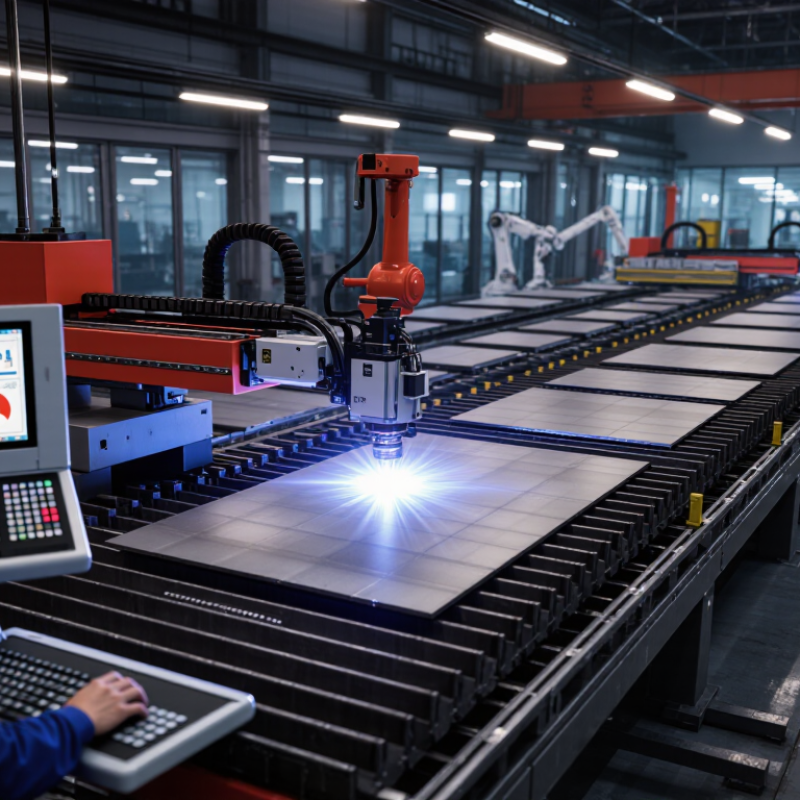
China’s laser cutting sector is moving from rapid adoption toward deeper process control. The current state is defined by fiber-laser systems, automated loading, and software-based production monitoring. The 2024 China Laser Industry Development Report describes continued growth in domestic laser-processing demand, especially from sheet-metal fabrication, new-energy equipment, and automotive supply chains. Yet market expansion does not guarantee stable quality.
The International Federation of Robotics reported 276,288 industrial robot installations in China during 2023, representing about 51% of global installations. This matters because laser cutting increasingly operates inside connected cells, not as an isolated machine. Operators now adjust focal position, assist-gas pressure, pierce timing, and cutting speed through shared production data. Small errors still matter. A dirty protective window can create rough edges within minutes.
Energy efficiency is becoming a practical concern. High-power systems can raise output, but thicker capacity may increase electricity use, cooling demand, and maintenance costs. The China Laser Industry Development Report also identifies intelligent manufacturing and higher-value processing as important industry directions. However, reported automation levels can hide uneven factory practices. Some workshops still depend heavily on manual parameter changes and informal experience. Standards, operator training, and traceable inspection remain less glamorous, but they decide whether a fast cut is truly reliable.
| Technology Dimension | Current Trend in China | Typical Data or Range | Practical Impact |
|---|---|---|---|
| Fiber laser adoption | Fiber lasers remain the dominant choice for industrial metal cutting because of their high electrical efficiency, low maintenance requirements, and suitability for reflective metals. | Commonly used wavelength: approximately 1.06–1.08 μm; electrical-to-optical efficiency is often around 25%–35%, depending on system configuration. | Lower operating cost and reduced maintenance compared with older gas-laser systems. |
| Higher laser power | Higher-power systems are increasingly used for thick steel plate, shipbuilding, construction machinery, energy equipment, and large-format fabrication. | Approximately 3–6 kW is widely used for general sheet-metal work; 10–20 kW is used for high-throughput or thicker-plate applications; systems above 20 kW remain more specialized. | Improves cutting speed and productivity, although material type, thickness, gas pressure, nozzle design, and beam quality remain critical. |
| Thin-sheet processing | High-speed cutting of mild steel, stainless steel, aluminum, and galvanized sheet is a major use case in appliance, furniture, electrical, and general fabrication industries. | Typical commercial machines process sheet from below 1 mm to approximately 20 mm, depending on the material and laser power. | Supports shorter production cycles, smaller batch sizes, and more flexible product designs. |
| Thick-plate cutting | High-power laser cutting is expanding into thicker carbon-steel and stainless-steel applications that were traditionally dominated by plasma or flame cutting. | Approximate practical ranges can reach 30–50 mm for carbon steel and lower ranges for stainless steel, subject to power, gas, edge-quality requirements, and machine design. | Can provide narrower kerfs and lower heat-affected zones, but operating cost and cutting stability increase with thickness. |
| Automation and material handling | Automatic loading, unloading, pallet changing, sheet storage, part sorting, and scrap removal are becoming standard features in high-utilization factories. | Automated systems can support unattended or lightly attended production during selected shifts; actual performance depends on sheet mix and line layout. | Reduces manual handling, improves safety, and increases machine utilization. |
| Digital production management | Laser cutting cells are increasingly connected with nesting software, production scheduling, shop-floor monitoring, and manufacturing execution systems. | Common functions include real-time status monitoring, job queuing, cutting-parameter libraries, production reporting, and remote diagnostics. | Improves material utilization, traceability, scheduling accuracy, and equipment management. |
| Artificial intelligence and process monitoring | Vision systems and data-based control are being introduced to detect nozzle condition, sheet position, piercing quality, sparks, and cutting interruptions. | Typical monitored variables include cutting head height, reflected light, gas pressure, pierce time, vibration, and machine temperature. | Helps reduce scrap, stabilize quality, and support predictive maintenance, although fully autonomous parameter optimization is still developing. |
| Tube and profile cutting | Dedicated tube and profile laser machines are increasingly used for steel furniture, fitness equipment, automotive components, construction products, and equipment frames. | Typical systems process round, square, rectangular, and channel profiles; common tube diameters are roughly 20–350 mm, depending on machine configuration. | Combines cutting, drilling, slotting, and marking in one process while reducing secondary machining. |
| Three-dimensional and robotic cutting | Three-dimensional laser systems and robot-mounted cutting heads are used for formed parts, vehicle components, irregular structures, and large workpieces. | Typical capabilities include multi-axis motion, automatic tool-center-point compensation, 3D CAD path import, and adaptive height control. | Enables flexible processing of complex geometries without dedicated dies or extensive tooling. |
| Green manufacturing | Manufacturers are focusing on lower electricity consumption, improved nesting, reduced assist-gas use, longer consumable life, and better scrap separation. | Fiber-laser systems generally require less electrical power and fewer consumables than comparable legacy gas-laser systems; savings vary by power level and operating schedule. | Supports energy reduction, lower waste, and compliance with increasingly demanding environmental targets. |
| Domestic supply-chain development | China has developed broad local manufacturing capacity for laser sources, machine tools, cutting heads, control systems, automation equipment, and auxiliary components. | Local availability covers a wide range of low-, medium-, and high-power equipment, while some high-end components and specialized applications may still rely on international supply chains. | Shortens lead times and supports price competition, customization, maintenance, and rapid equipment upgrades. |
| Application expansion | Demand is expanding beyond conventional sheet-metal workshops into new-energy equipment, transportation, construction machinery, agricultural machinery, kitchen equipment, and customized fabrication. | The strongest adoption is generally associated with applications requiring high mix, fast changeover, precise contours, and limited tooling. | Broadens the addressable market and increases demand for application-specific systems rather than one-size-fits-all machines. |
Note: The figures shown are representative industry ranges for China’s current laser-cutting market. Actual performance varies according to material grade, thickness, laser power, cutting gas, machine structure, software, and required edge quality.
They connect sensors, cameras, and production software. Operators can track power, speed, gas pressure, and nozzle condition.
Robotic loaders move steel plates, sort finished parts, and return reusable remnants. They also reduce repetitive lifting.
Software arranges cutting patterns closely across each sheet. This can leave fewer unused scraps near the collection bin.
No. A dirty window, poor calibration, or warped sheet can still reduce accuracy. Machines are clever, not magical.
Technicians check focus height, kerf width, heat distortion, and edge quality. Unusual material behavior can confuse automatic alerts.
It estimates when optics, rails, or cutting heads may need service. The real benefit is fewer surprise stoppages.
One cell may combine cutting, loading, bending, inspection, and data tracking. A camera could reject a warped sheet before cutting.
They should review testing records, service commitments, training plans, and measurable savings. Impressive demonstrations are not enough.
Probably not. Operators still manage material changes, edge quality, and unsafe conditions. Some predictions may fail in smaller workshops.
Systems using less standby power, compressed air, and material may lower operating costs. The savings should be measured, not assumed.
China’s laser cutting industry is moving from traditional equipment toward faster, more precise, and more intelligent production systems. What are the latest trends in laser cutting technology? The main developments include higher-power laser sources, improved beam control, greater cutting accuracy, and energy-efficient designs that can process a wider range of metals and materials. New innovations are also improving system stability, reducing maintenance needs, and supporting more flexible production.
Automation and smart manufacturing are becoming central to the market. Laser cutting machines are increasingly connected with robotic loading and unloading, digital monitoring, production scheduling, and real-time quality control. These solutions are widely used in automotive manufacturing, construction machinery, electronics, kitchen equipment, metal furniture, and general fabrication. Looking ahead, China’s market is expected to focus on deeper integration with industrial software, more adaptive cutting processes, enhanced energy efficiency, and customized production. Together, these trends will help manufacturers improve productivity, reduce material waste, and respond more quickly to changing customer requirements.

 CXO Laser