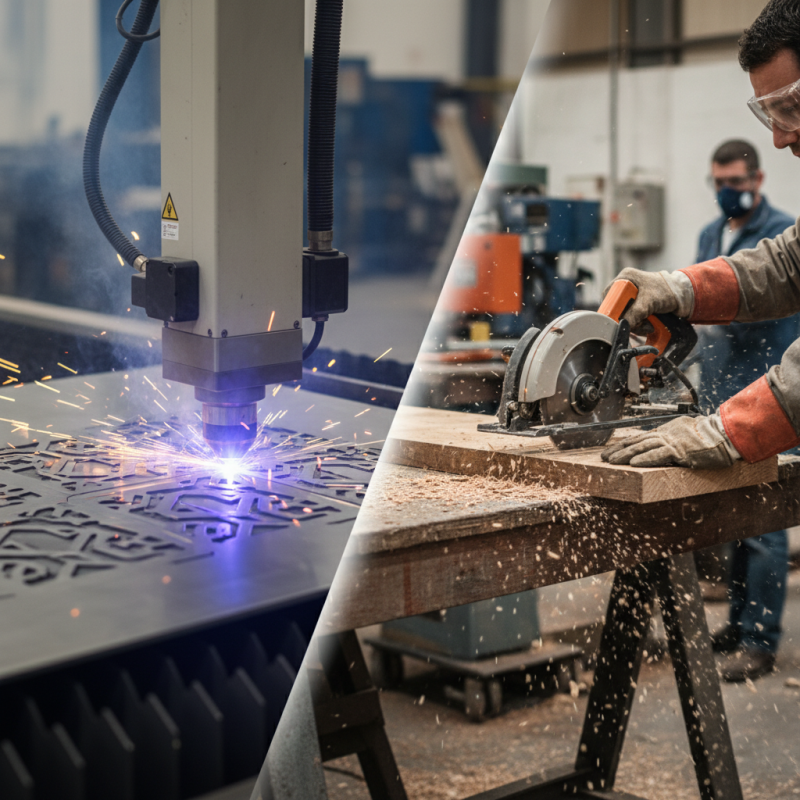
Laser cutting and mechanical cutting are widely used in various industries. Both methods have unique characteristics. Understanding what is the difference between laser cutting and mechanical cutting is essential for making informed choices.
Laser cutting uses focused light beams to cut materials. This method is precise and efficient. It can handle intricate designs without much effort. On the other hand, mechanical cutting involves physical tools like blades and saws. It typically requires more manual labor. The precision of mechanical cutting can be affected by tool wear and material thickness.
Considering these processes' benefits and limitations is important. Each method has its merits. While laser cutting excels in speed and detail, mechanical cutting may offer flexibility in more robust materials. Factors such as cost and material choice should be evaluated. Ultimately, the choice hinges on specific project requirements.
Understanding Laser Cutting: Principles and Applications
Laser cutting has revolutionized various industries by offering precision and efficiency. This technology operates on the principle of focusing a high-powered laser beam to melt, burn, or vaporize materials. Common applications include metal fabrication, aerospace engineering, and art design. According to industry reports, the global laser cutting market was valued at approximately $4.84 billion in 2020 and is expected to grow significantly. This growth highlights the increasing demand for high-quality manufacturing processes.
Laser cutting's advantages set it apart from traditional mechanical cutting methods. For instance, laser cutting can achieve intricate designs that mechanical methods may struggle to replicate. This precision reduces material waste and enhances productivity. However, not all applications benefit equally.
For thicker materials, laser cutting may take longer and be less effective. Mechanical cutting may still outperform in these scenarios, highlighting the need for careful application assessments.
Moreover, laser cutting requires suitable safety measures due to high-intensity lasers. Overall, while it offers remarkable capabilities, recognizing its limitations is essential. The choice between laser cutting and mechanical cutting often hinges on the specific requirements of the task at hand, emphasizing the importance of understanding both methods thoroughly.
Mechanical Cutting Techniques: Overview and Industry Uses
Mechanical cutting is a traditional method widely used in various industries. It typically involves tools like blades or saws to remove material. This process can create precise shapes and edges. However, achieving high accuracy often requires skilled operators. Misalignments can lead to wasted materials.
In sectors like manufacturing and construction, mechanical cutting techniques are essential. For instance, in metalworking, shearing is common for cutting sheets. While effective, these methods may struggle with complex designs. Customization poses challenges that can slow down production. Additionally, tool wear impacts performance, necessitating regular maintenance and replacement.
Despite its advantages, mechanical cutting is not always the perfect solution. It can be slower than laser cutting, limiting efficiency in high-volume tasks. Operators may encounter issues such as burr formation, leading to further refinement. Understanding these limitations encourages industry professionals to explore complementary techniques, ensuring quality and precision.
Key Differences Between Laser and Mechanical Cutting Processes
Laser cutting and mechanical cutting are two essential processes in manufacturing. They differ significantly in technique and application.
According to a report from Research and Markets, the laser cutting market is expected to reach $5.45 billion by 2025, indicating a growing preference for this technology.
Laser cutting uses a focused beam of light to melt and vaporize materials with high precision, making it ideal for intricate designs. A key advantage is its ability to cut through various materials, including metals and plastics, with thicknesses up to 20 mm.
In contrast, mechanical cutting employs tools such as saws or blades. It relies on the physical contact of cutting edges to separate material.
This method often produces greater stress on the workpiece, which can lead to deformation or warping, especially in softer materials.
A survey by the Fabricators & Manufacturers Association found that 40% of companies still rely on mechanical cutting due to its lower initial costs, even though it may result in a rougher finish.
The choice between these methods often reflects a balance between cost and precision, with laser cutting offering less waste and cleaner edging at potentially higher operational expenses.
Material Suitability: When to Choose Laser vs. Mechanical Cutting
When selecting the appropriate cutting method, material suitability plays a crucial role. Laser cutting is widely regarded for its precision and versatility, especially with thinner materials. According to a 2021 industry report, laser cutting can achieve tolerances of ±0.1 mm, while mechanical cutting methods may deviate by up to ±0.5 mm. This level of accuracy is particularly valuable in industries such as aerospace and electronics, where exact dimensions are paramount.
On the other hand, mechanical cutting excels in handling thicker materials. It is often more effective for metals over 10 mm thick. Studies show that mechanical cutting can deliver faster processing speeds at such thicknesses. Additionally, the wear and tear on laser equipment can be significant. Maintaining a laser system incurs higher operational costs compared to mechanical systems, particularly during heavy use.
Choosing between laser and mechanical cutting requires thoughtful consideration. Each method has distinct advantages and limitations. For businesses, understanding the material characteristics is essential. Not all materials respond equally to these cutting techniques. For instance, some composites may suffer from heat-affected zones when lasered, compromising integrity. Hence, assessing both method advantages and material properties becomes crucial for optimal decision-making.
Cost Efficiency and Production Speed: A Comparative Analysis
Laser cutting and mechanical cutting are two different processes, each with its own strengths and weaknesses. When it comes to cost efficiency, laser cutting often has the upper hand for intricate designs. The technology allows for rapid processing of complex patterns without the need for extensive tooling. However, this does not always translate to lower overall costs. Material waste can be a concern with laser cutting, which might offset some savings.
Mechanical cutting, on the other hand, usually involves higher initial setup costs. But it can be more cost-effective for larger production runs of simpler parts. The durability of mechanical tools means they can handle tough materials better in some cases. It is also a more established method, making it easier to find experienced operators in the workforce.
Tips: Consider the design intricacy when choosing the cutting method. Simple shapes may benefit from mechanical cutting, while complex designs can shine with laser technology. Also, calculate the total cost, including material waste and setup time, before making your decision. Finally, think about future projects. If the designs are likely to change, laser cutting offers greater flexibility without the need for new tooling.
How to Understand the Difference Between Laser Cutting and Mechanical Cutting? - Cost Efficiency and Production Speed: A Comparative Analysis
| Cutting Method |
Cost Efficiency |
Production Speed |
Material Compatibility |
Precision |
| Laser Cutting |
Higher initial costs, but lower long-term operational costs for mass production |
Faster processing speeds, especially for complex designs |
Metal, wood, fabric, plastic, and more |
High precision with intricate designs |
| Mechanical Cutting |
Lower initial costs, more economical for small batches |
Slower speeds, may require more setup time |
Metal, plastics, wood, and other conventional materials |
Good precision, but less capable for complex shapes |
FAQS
: Laser cutting uses a high-powered laser beam to melt or vaporize materials for precision shaping.
It offers intricate design capabilities, reduces material waste, and enhances productivity compared to mechanical methods.
Industries include metal fabrication, aerospace engineering, and art design.
Yes, it may be less effective for thicker materials and can require longer processing times.
Laser cutting is cost-efficient for complex designs, while mechanical cutting can be cheaper for large, simple production runs.
Appropriate safety equipment and procedures are essential due to the high-intensity lasers involved.
Consider mechanical cutting for simple shapes or when experienced operators are easily available.
Assess design complexity, total costs, material waste, and potential future project changes before deciding.
Yes, it offers greater flexibility without needing new tooling for changing designs.
Yes, material waste can offset savings, highlighting the need for thorough cost analysis.
Conclusion
This article explores what is the difference between laser cutting and mechanical cutting by breaking down their principles, applications, and industry uses. Laser cutting utilizes focused light beams to precisely cut materials, making it ideal for intricate designs and thin materials. In contrast, mechanical cutting employs physical tools like blades or chisels, commonly used for thicker materials and faster processing in industries such as manufacturing and woodworking.
The article further examines the key differences in processes, including material suitability and production speed. While laser cutting is preferred for delicate and detailed work, mechanical cutting offers efficiency in bulk operations. Additionally, a comparative analysis highlights the cost efficiency of both methods, helping industries determine when to choose one over the other based on project needs and budget constraints.

 CXO Laser